
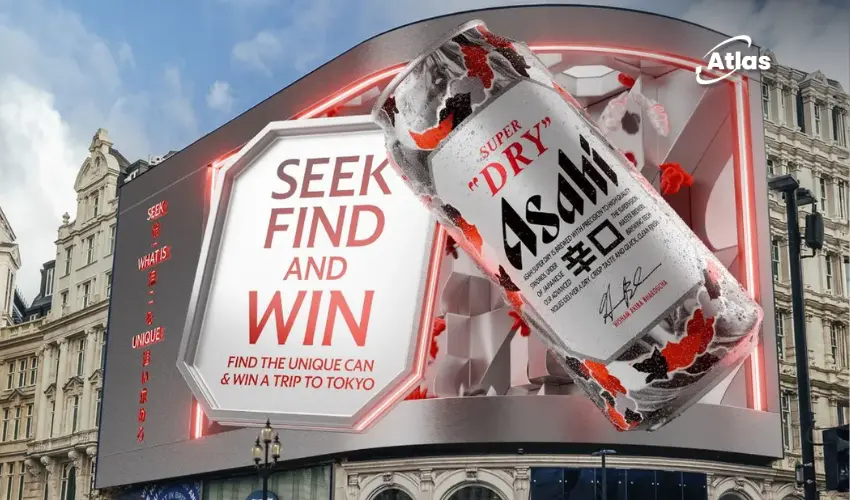
Asahi Super Dry Creates an Infinite AI-Powered Billboard at Piccadilly Circus
Most outdoor campaigns are built around a small number of creative executions repeated throughout their media run.
Asahi Super Dry is taking a different approach with “The Infinite Can,” a digital out-of-home campaign designed to appear different almost every time audiences encounter it.
The project combines original artwork by Japanese-born, New York-based artist Hisham Akira Bharoocha with a custom generative AI system to create more than 400 distinct compositions inspired by Japanese culture and rendered in Asahi Super Dry’s visual identity.
The campaign debuts through a week-long takeover of London’s iconic Piccadilly Lights, including a large-scale three-dimensional hero can developed specifically for high-impact OOH environments.
An outdoor campaign that is never the same twice
The Infinite Can was created around Asahi Super Dry’s global brand platform, “Seek What Is Unique.”
Instead of using one finished artwork as the center of the campaign, the brand built a system capable of continually producing new visual combinations.
Over the course of the Piccadilly Lights takeover, audiences can encounter hundreds of different compositions featuring changing colors, shapes, symbols and visual connections.
This makes the billboard feel less like a repeated advertisement and more like a constantly evolving public artwork.
Combining artistic intelligence with artificial intelligence
The campaign was developed by Havas London and Prose on Pixels, Havas’ global content production network, in close collaboration with Bharoocha.
At the center of the production process is the Asahi Fusion Designer, a custom orchestration tool created within Prose on Pixels’ Vermeer.ai platform.
The system was trained exclusively using Bharoocha’s artistic output, creative process and personal influences. However, its purpose was not to directly imitate or reproduce his established style.
Instead, the technology was designed to identify recurring themes, emotions and connections within his work and use those insights to generate new visual possibilities.
Bharoocha remained involved throughout the process, selecting source material, directing the creative nuance and deciding which generated results authentically reflected his artistic perspective.
Why the artist’s perspective matters
Bharoocha was born in Japan, has Japanese and Burmese heritage and grew up partly in North America. This cross-cultural background is central to his work.
His art frequently combines eastern and western influences, connecting personal experiences with broader cultural symbols through graphic patterns, abstract forms and layered compositions.
That perspective aligns naturally with Asahi Super Dry, a Japanese brand with an increasingly global presence.
Rather than treating Japanese culture as a decorative theme, the campaign uses an artist whose identity and creative process already explore the relationship between different cultures.
The resulting artworks translate Bharoocha’s visual DNA into the silver, black and red palette associated with the Asahi Super Dry can.
Why Piccadilly Lights is central to the idea
Piccadilly Lights is one of the United Kingdom’s most recognizable digital advertising locations. Its scale, audience traffic and cultural visibility make it an appropriate environment for a campaign built around continuous transformation.
The screen allows the generated designs to appear at a size and level of detail that would be difficult to achieve through smaller formats.
It also gives the campaign a sense of performance. The changing artwork becomes something audiences can stop, observe and potentially encounter differently during each visit.
A three-dimensional hero can adds another layer to the activation, using the screen’s scale and perspective to make the limited-edition packaging appear to emerge from the digital display.
Generative AI as part of the creative idea
Many campaigns use artificial intelligence primarily to accelerate production or create multiple asset variations.
In The Infinite Can, the technology is more closely connected to the central creative concept.
The campaign promises audiences something unique and constantly changing. Generative AI provides the volume and flexibility required to make that promise visible across hundreds of outdoor executions.
The structural planning, prompts and creative rules were established before production, allowing the system to operate within a defined artistic and brand framework.
This distinction is important. The AI was not added after the concept was developed as a promotional feature. It was necessary for the concept to function at the intended scale.
From the billboard to limited-edition packaging
The campaign extends beyond Piccadilly Circus through a limited-edition Asahi Super Dry can and bottle designed by Bharoocha.
The packaging sits at the center of the brand’s new “Seek, Find & Win” competition, which will appear across one million packs of Asahi Super Dry and Asahi Super Dry 0.0% in the United Kingdom.
Consumers who discover selected cans or bottles can win prizes, including trips to Tokyo, the home of Asahi Super Dry.
This creates a direct connection between the outdoor campaign and the physical product. The artwork seen at large scale on Piccadilly Lights can also be found on packaging in stores, pubs and bars.
The design therefore moves between several environments:
- Landmark OOH: Building awareness and visual impact through Piccadilly Lights.
- Additional outdoor media: Extending campaign reach across other UK locations.
- Retail packaging: Turning the product itself into a collectible campaign asset.
- Point of sale: Making the activation visible in grocery stores, convenience stores, pubs and bars.
- Social and online video: Expanding the story behind the artist, technology and creative process.
Turning discovery into participation
The Seek, Find & Win promotion transforms the brand platform from an abstract message into an audience activity.
Consumers are encouraged to look for unique cans, bottles and promotional tokens, reinforcing the idea of seeking unusual experiences.
The campaign will also appear in venues serving Asahi Super Dry on draught, where customers can discover tokens offering merchandise, credit for drinks and additional opportunities to win trips to Tokyo.
This gives the wider campaign a clear participation mechanism. Outdoor media creates curiosity, packaging provides discovery and the competition offers a reward for engagement.
A connected brand experience
The strongest aspect of The Infinite Can is the way its different elements support the same central idea.
The artwork changes continuously on the billboard. The packaging encourages consumers to search for unique designs. The promotion rewards discovery. The brand platform invites people to explore a more creative and interesting side of life.
Each channel performs a different role, but all of them reinforce the concept of seeking something distinctive.
This consistency prevents the AI technology, artist collaboration and promotional competition from feeling like unrelated additions.
Bottom line
Asahi Super Dry’s Infinite Can campaign demonstrates how generative AI can become a meaningful part of an outdoor creative system.
By combining Bharoocha’s cross-cultural artistic perspective with a custom-built generative platform, the campaign produces more than 400 designs without removing the artist from the creative process.
The Piccadilly Lights takeover gives those artworks landmark scale, while limited-edition packaging and the Seek, Find & Win competition extend the idea into stores, pubs and consumer participation.
The result is not simply an advertisement that uses AI. It is a connected brand experience designed around continuous creativity, discovery and the possibility of seeing something different with every encounter.
Plan your OOH campaign
Get recommendations for markets, formats and availability based on your campaign goals.
Request a media plan
Comments
Share your take. Keep it constructive and specific.