
Ancestry Highlights the Missing Women in Recorded History
Ancestry has launched “The Parity Principle”, a new measure created to help historians, educators and the public examine whether historical works provide a fuller picture of the past by including the experiences of both men and women.
The initiative responds to a significant imbalance in recorded history. According to research from Ancestry, a review of UK KS3 history textbooks found that men are mentioned four times more often than women, with men accounting for 81% of named historical figures compared with just 19% for women.
The campaign highlights how this absence shapes public understanding. More than half of the public say they feel more confident naming male historical figures than female ones, while nearly two-thirds fear that AI trained only on traditional historical materials could continue to overlook women’s experiences.
A Framework for More Complete History
Developed by Ancestry and historian Dr. Amy Boyington, The Parity Principle was inspired by the Bechdel Test for fiction. It provides a simple set of criteria to help assess whether historical content reflects the lives, achievements and experiences of both men and women.
The framework arrives at an important moment for education. Nearly four in five teachers surveyed agreed that a simple, standardised framework would help them include more diverse perspectives in their lessons.
The Missing Pages Installation
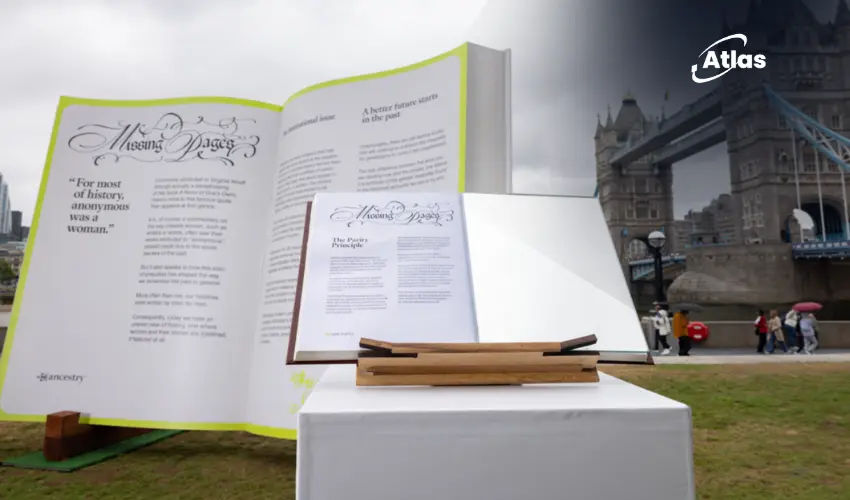
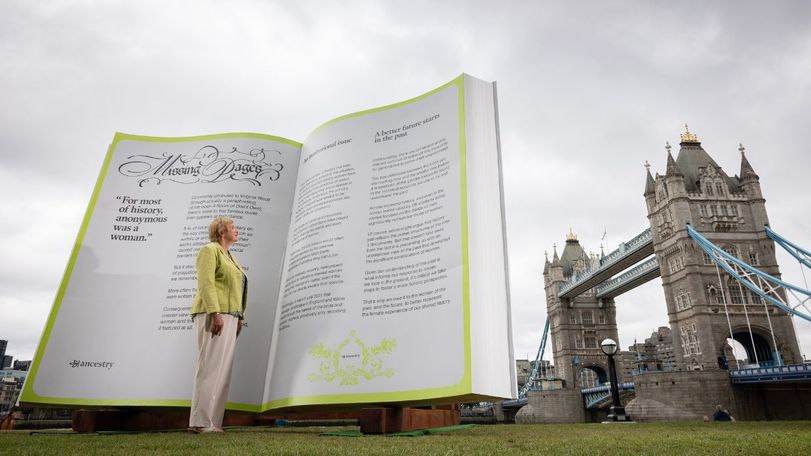
To bring the issue into public view, Ancestry unveiled its Missing Pages installation at London’s Potters Field Park.
The installation acts as a powerful visualisation of the research, showing how women account for only 19% of named historical figures in UK KS3 history textbooks, while 81% of the content focuses on men’s lived experiences.
By placing the message in a public environment, Ancestry transforms a textbook problem into a shared cultural conversation. The installation makes the imbalance visible, accessible and difficult to ignore.
Looking Beyond Mainstream Historical Records
Alongside the framework, Ancestry is encouraging the public to look closer to home by exploring the women who came before them in their own families.
To demonstrate the depth of stories waiting to be discovered, Ancestry partnered with Historic England to highlight 25 remarkable women championed through public nominations to the National Blue Plaque scheme.
Through records such as the 1921 Census of England and Wales on Ancestry, the campaign brings attention to unsung female war heroes, pioneering scientists, early policewomen and other women whose achievements have often remained outside mainstream recognition.
The Human Cost of Missing Women’s Stories
The campaign makes clear that the omission of women from recorded history is not only an academic issue. It affects how people understand achievement, leadership and modern gender roles.
Among the women highlighted are Dr. Annie Hyatt, one of fewer than 500 female doctors in Edwardian Britain and the first woman appointed Deputy Medical Officer of Health, and Mary Cartwright, a groundbreaking mathematician whose work helped lay the foundations for chaos theory and the Butterfly Effect.
Despite their contributions, both women remain far less widely known than many of their male contemporaries. Ancestry uses their stories to show that the problem is not a lack of inspiring women in history, but a lack of visibility.
Why the Campaign Matters
- It identifies a measurable imbalance: Women account for just 19% of named figures in the reviewed KS3 history textbooks.
- It creates a practical framework: The Parity Principle gives educators and historians a simple way to assess representation.
- It makes the issue public: The Missing Pages installation turns research into a visible cultural moment.
- It connects national history to family history: Ancestry encourages people to discover the women in their own family records.
- It looks ahead to AI: The campaign raises concerns about how historical bias could be repeated in future technologies.
Bottom Line
Ancestry’s “The Parity Principle” campaign shows how a brand can use research, public space and cultural storytelling to challenge how history is recorded and remembered.
By combining a practical framework with the Missing Pages installation, Ancestry reframes gender bias in history as both a public issue and a personal one, encouraging people to look again at the women whose stories have been left out for too long.
Comments
Share your take. Keep it constructive and specific.